



.webp)
.webp)


Q: How did you start working with K9s?
It started during a talk I gave in the US, where I mentioned how difficult pink fairy armadillos are to study. The CEO of Global Conservation Force, who is also a K9 handler, came up to me afterwards and asked whether I had ever considered using scent detection dogs to search for them.
That question really caught my attention. I had always been fascinated by working dogs, but I couldn't imagine how a dog could find a tiny armadillo that spends almost all of its time underground. He introduced me to the experts at Scent Imprint for Dogs in the Netherlands, who were very enthusiastic about the idea. I then travelled to the Netherlands for handler training and to start learning how to work with a detection dog. That was the beginning of a completely new direction in my research, and my introduction to the fascinating world of scent detection dogs.
Q: What are some unique aspects of your K9 partner?
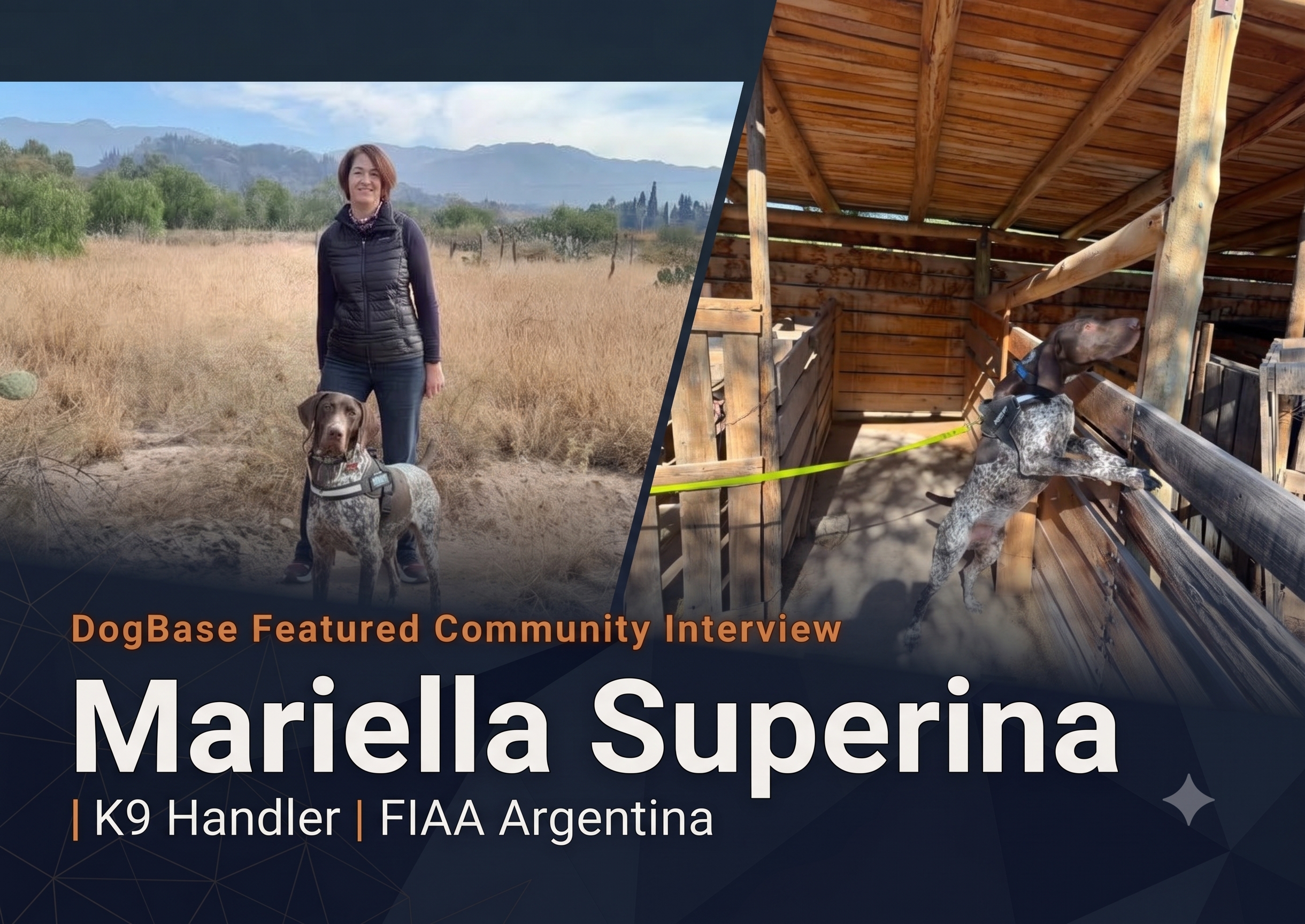
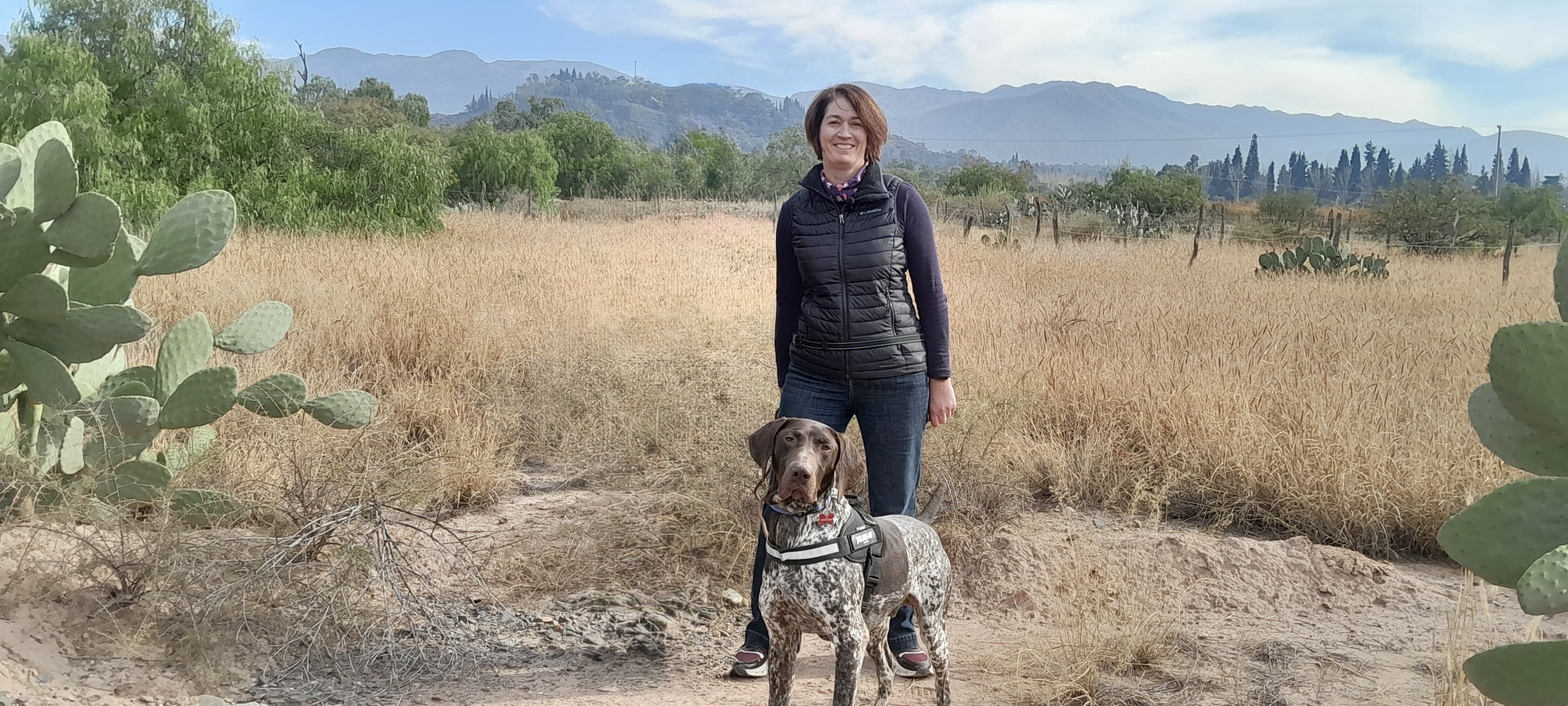
Roy is a very special partner because, in many ways, he knows more about scent work than I do! He is goofy, fun, affectionate, and also a beautiful dog; people regularly stop me in the street to ask about him.
He was originally trained as a tracking dog, but he adapted quickly to completely new tasks. He learned to search for pink fairy armadillos underground and for kissing bugs in sheds and vegetation. What amazes me is that he was trained in a very different environment in the Netherlands and then came to Mendoza and had to learn to work in a completely different climate, landscape, and range of scents. We are really learning together: he is learning new targets and environments, while I'm learning how to understand and work with him.
Q: Can you share some challenges and triumphs?
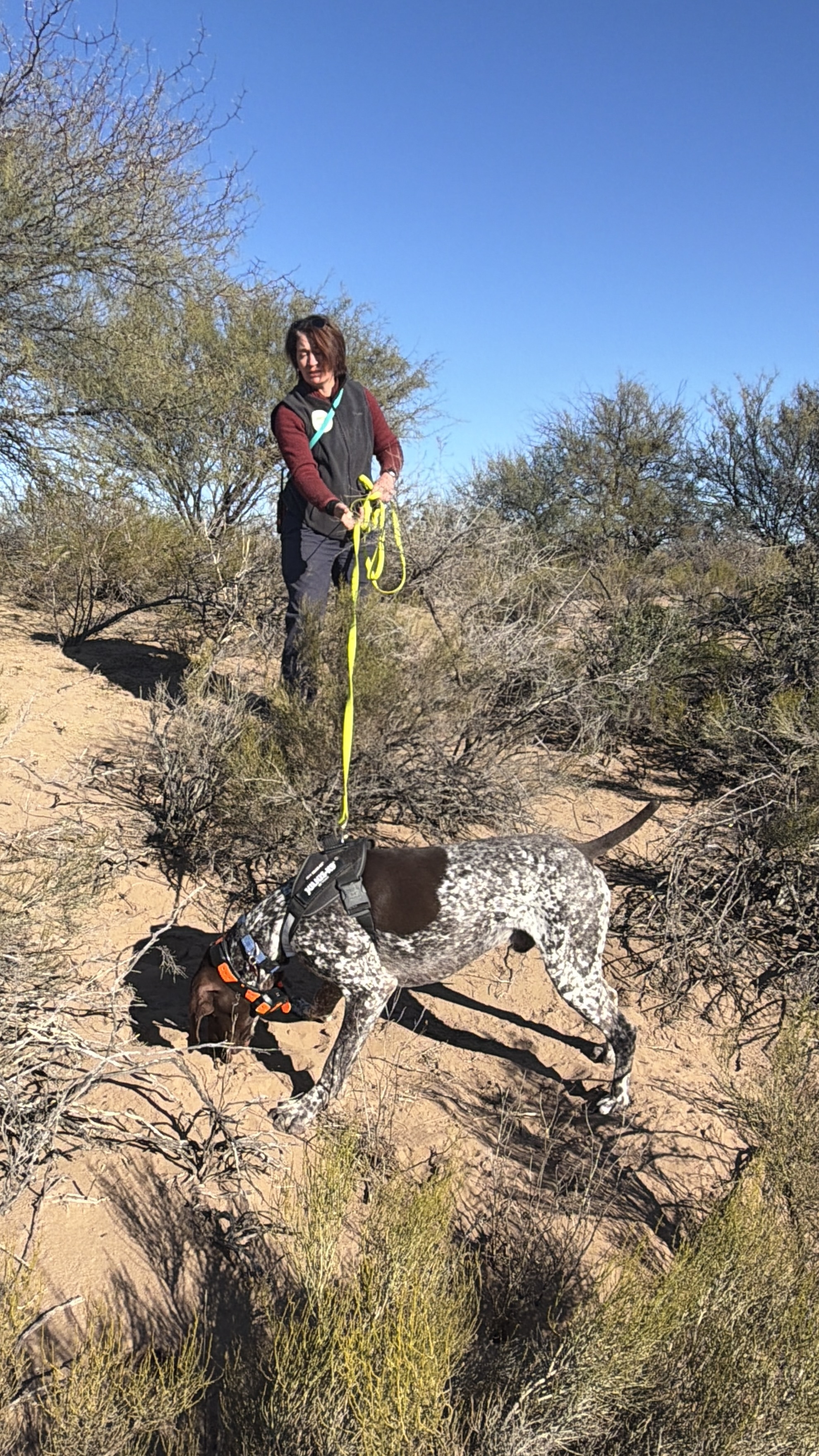
One of the biggest challenges is the habitat. Mendoza's spiny shrubland is not an easy place for a dog to search, but Roy is a fast learner and has adapted well. I'm also learning a lot about scent itself, including how it disperses through the air and, even more importantly for our work, how it moves underground. Understanding this is essential for interpreting Roy's indications.
A really exciting moment came when one of Roy's Dutch trainers came to Mendoza to work with us in the field. We searched an area that we thought could be suitable for pink fairy armadillos. Roy completely ignored all the rodent burrows, but made a strong indication in an area where we could only interpret the scent as potentially coming from a pink fairy armadillo. Six weeks later, we returned to the same area and Roy indicated very close to the original spot. It looks like we may have already found our first pink fairy armadillo!
Q: Describe the bond you share with your K9.
Roy is very close to both me and my husband, and he is happiest when he is around us. He loves to cuddle and play with one of our other dogs, and he is very much part of our daily life, so the relationship is not only about training and work.
For me, building that trust is also an important part of becoming a better handler. I'm still figuring out how to read his behavior and understand what he is telling me when we are working. The better I know him, the easier it becomes to recognize the small differences in his behavior, including when he has genuinely found something and when he may just be trying to convince me that he has!
Q: What does daily life and training look like for you and your K9?
It's winter in Mendoza now, so the kissing bugs are not active and pink fairy armadillos are also more difficult to find. For that reason, much of our current work is focused on training. We do daily sessions where I hide target scent for Roy to find, as well as blank searches where there is no target scent. These sessions help us maintain his skills and also give me more opportunities to practice reading his behavior.
We also go for walks every day to keep him active and give him time to explore and just be a dog. I think that balance is important. Not every interaction with Roy needs to be training.
Q: Tell us a little about the K9 unit you're a part of.
It's really just Roy and me! There are not many conservation detection dogs in Argentina yet, so there isn't really a formal K9 unit that we are part of.
I'm in regular contact with the trainers at Scent Imprint for Dogs in the Netherlands, who continue to advise us as we work in the field. I've also exchanged ideas and experiences with the few conservation dog handlers currently working in Argentina, as well as with a researcher in Paraguay who was the first to use scent dogs to search for kissing bugs. So while our "unit" is very small, we are part of a growing network of people using dogs for conservation and research.
Q: Describe a recent mission or case where your K9 unit made a significant difference.
We haven't had a major "mission" yet! Our project is still in its early stages. But Roy and I have already had an unexpected impact through the attention the project has received in Mendoza. I've given several interviews recently about our work, which has given me the opportunity to explain what conservation detection dogs can do and why scent work can be such a powerful tool for research.
So, while Roy hasn't solved a big case yet, he is already helping me introduce people to a completely different way of thinking about what dogs can contribute to conservation and science. I think that is a pretty good start!
Q: What are some of the biggest challenges faced by K9 units in your field?
Funding is probably one of the biggest challenges, especially in Argentina, where funding for scientific research is currently extremely limited. Conservation detection dogs require investment in training, equipment, travel, and daily care, and all of this is difficult to cover through research funding alone.
This has also made community support very important. I have two wonderful volunteers who have helped me produce short videos about the project for fundraising and communication. Their help has been incredibly valuable, not only because of the practical work they do, but because they are helping us tell the story of what Roy is doing and why this research matters. More information about the project can be found here: https://fiaa-argentina.org/scent-dogs-to-detect-the-pink-fairy-armadillo/
Another challenge is that conservation detection dogs are still relatively new in many places. I constantly have to explain that Roy does not come into contact with a pink fairy armadillo. He doesn't bark at it or dig it out. He simply indicates where he detects its scent. This is really important for conservation work: the dog should not disturb the target species or any other wildlife in the area.
Q: What advice would you give to aspiring K9 handlers?
I'm probably not the best person to give advice to aspiring K9 handlers because I'm still learning myself! But I would strongly recommend getting thorough training from experienced professionals before starting a project like this. There is much more to it than teaching a dog to find a scent.
It is also a big commitment. The dog becomes part of your life every single day, not just when you are working. You need time, patience, and a willingness to keep learning. But it is incredibly rewarding and a lot of fun. My biggest lesson so far is to listen to your dog, get to know them really well, and be prepared to let them teach you.
Q: How can the public support K9 units and their important work?
Support us! Conservation detection dogs need the same kind of support as any other conservation project, and funding is one of our biggest challenges.
But support doesn't always have to mean money. People can help by sharing our work, talking about the role of scent dogs in conservation, volunteering their time or skills, and helping us reach people who might be interested in supporting the project. Even simply being curious and asking questions helps raise awareness about what these dogs can do.
In our case, we have already been incredibly lucky to have volunteers who help with communication and fundraising. Building a community around the project is just as important as training the dog.
Q: How did you discover DogBase?
As a scientist, I like data, and I need to keep detailed records of our training. I was looking for a practical and easy way to do this, so I searched online and found DogBase. I signed up for the trial period and liked the way the app was structured, especially because I could customize it.
I was also offered an online session for a quick demo and to help customize my account. The DogBase team took all the time needed to understand my project and what I wanted to record, and then helped me set up custom training sessions. It was actually a lot of fun! I was able to add fields for the different toys I use as rewards, Roy's interest in each one, and other details that will be important for my scientific analyses. That combination of flexibility and genuinely personal customer support convinced me that DogBase was the right app for us.
Q: How has DogBase impacted your work with your K9/unit?
DogBase has made it much easier for me to stay organized. Roy and I are working on two very different projects, one involving kissing bugs and the other pink fairy armadillos, so I need to keep track of which type of training we did, how long it lasted, where and when we trained, and many other details.
Having all of this recorded also helps me avoid falling into predictable routines. For example, I don't want to always train kissing bugs for two days followed by two days of armadillos, or always train in the same place on a particular day. By looking back at our training history, I can vary the sessions and keep things less predictable for Roy. That makes the training more interesting and challenging for him, while also giving me a much better record of our progress.
Q: What are your favorite features of DogBase?
The customizable training sessions are probably my favorite feature because I can adapt them to the very specific needs of our work. I also really like the Intelligent Recap, which gives me a quick overview of our training history.
The Health Center is useful for keeping track of Roy's deworming and vaccination schedule, so I have his routine care recorded in the same place as his training.
And as a scientist, I absolutely love being able to export all our training data to an Excel file. Being able to take all that information and analyze it myself makes my scientist heart sing!
Q: What suggestions do you have for future development of the platform?
I think DogBase is already an amazing app because it can be adapted to such a wide variety of training types and user needs. The level of customization is one of its greatest strengths.
One feature that would be really useful for me would be a way to highlight or mark specific training sessions on the Training dashboard. For example, I wanted to find the session where Roy probably found a pink fairy armadillo, but I did not remember the exact date. Being able to mark especially important trainings with a star, a color code, or another type of highlight would make it much easier to find key moments later.
For a working dog, there are often individual training sessions that become important milestones, and having a simple way to flag those would be a great addition.
Learn More About the Pink Fairy Armadillo (Chlamyphorus Truncatus)