




.webp)
.webp)

.webp)


You finish a long search block, pull out the thermometer, and it reads 105.5°F. Your stomach drops.
But for a fit, acclimated working dog that's often exactly what hard work looks like. The same 105.5°F on a dog that's been lying in the truck all morning is a very different problem.
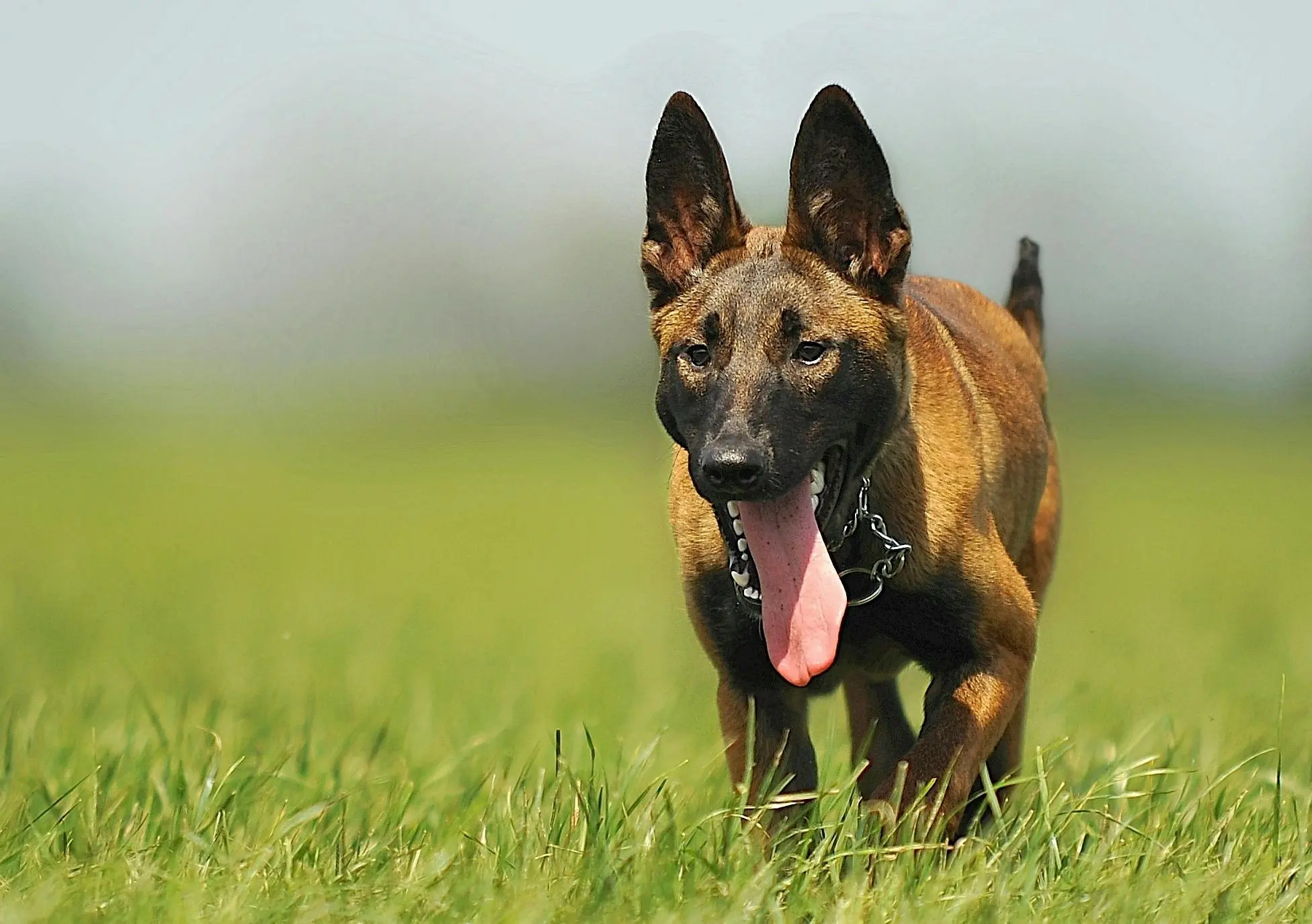
I've been running SAR with my Malinois, Echo, for years, and this is the thing most temperature charts get wrong for us. They give you one "normal" range, written for a dog that sleeps on the couch. A working dog's temperature only means something when you know when you took it: at rest, right after work, or while you're cooling him down.
In our last post we covered why heat records belong in the Health Center. This one is the field chart: what each reading means, and what to do next, based on the US military's veterinary guidance for working dogs.
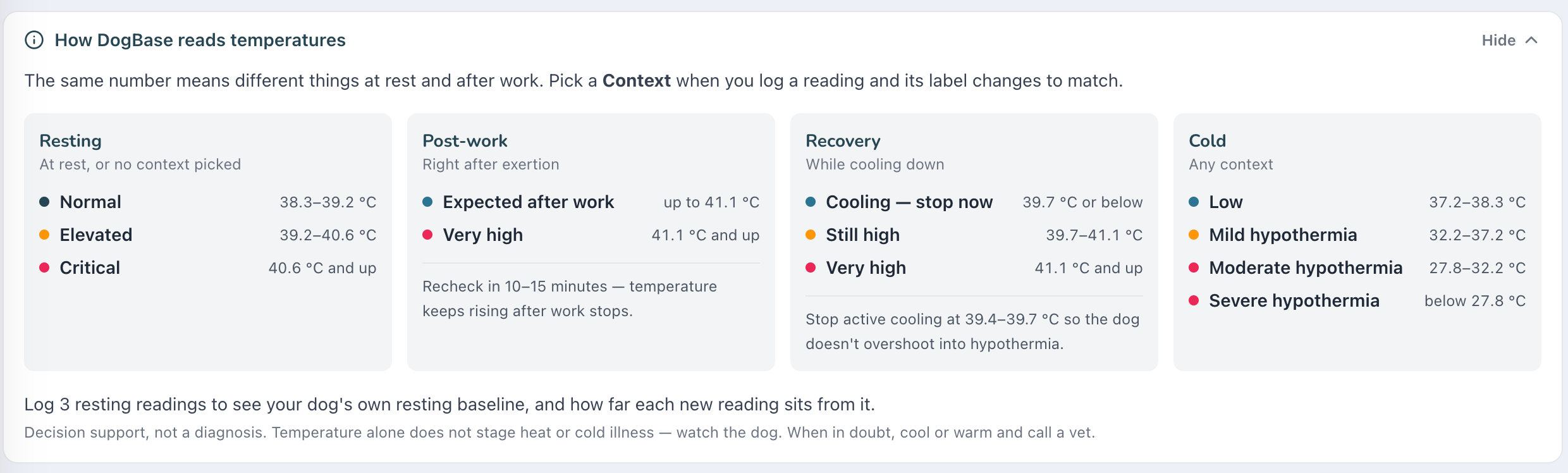
At rest: 101 to 102.5°F (38.3 to 39.2°C)
A resting reading is your reference point. Take it when the dog has been calm for a while, not straight out of the crate after a bark fest.
- 101 to 102.5°F (38.3 to 39.2°C): Normal.
- 102.5 to 105°F (39.2 to 40.6°C): Elevated. Recheck and watch for signs of heat stress or illness.
- 105°F (40.6°C) and up: Critical. Nothing explains it, so call a vet.
- 99 to 101°F (37.2 to 38.3°C): Low. Recheck and keep the dog dry and out of the wind.
The key word is "explains." At rest there's no exertion behind a high number, so 104°F means something is wrong until you prove otherwise. Fever, infection, a dog left in a hot vehicle. Treat it that way.
Right after work: up to 106°F (41.1°C) can be normal
This is where handlers panic for no reason, or relax when they shouldn't.
The US military's Joint Trauma System guideline for military working dogs says rectal temperatures above 106°F are common during exercise, with no ill effects. A 2017 study of working dogs exercising in the heat at the Penn Vet Working Dog Center backs it up: post-work temperatures averaged 105.4°F and peaked at 108.3°F, and no dog needed medical help.
So a post-work reading needs its own scale:
- Up to 106°F (41.1°C): Expected after hard work. Rest, water, recheck.
- 106°F (41.1°C) and up: Very high. Check for heat stroke signs and start cooling.
One caution. The same guideline is clear that there's no single number that defines heat stroke. Damage has been linked to temperatures as low as 105.8°F, and heat stroke is most common above 107°F. That's why the number is only half the picture. More on that below.
Take a second reading 10 to 15 minutes later
Here's the part most handlers miss. Core temperature doesn't peak when the dog stops working. According to the JTS guideline, it keeps rising for about 15 minutes after exercise ends.
So the reading you take as you clip the leash on isn't the high point. Take another one 10 to 15 minutes later.
That second number tells you more than the first. If it's dropping, the dog is recovering on his own. If it's still climbing past 106°F, start cooling. Don't wait to see where it tops out.
Cooling: stop at 103 to 103.5°F (39.4 to 39.7°C)
Once you start cooling a dog, the instinct is to keep going until he feels normal. That's how you overshoot.
The JTS guideline says to stop active cooling when the dog reaches 103 to 103.5°F. His temperature will keep drifting down on its own after that. Push past it and you risk rebound hypothermia, which is the last thing a dog coming off heat stress needs.
During recovery, read every number against that stop line:
- 103.5°F (39.7°C) or below: Stop active cooling now.
- 103.5 to 106°F (39.7 to 41.1°C): Still high. Keep cooling and recheck.
- 106°F (41.1°C) and up: Very high. Keep cooling, watch for heat stroke signs, call a vet.
It sounds backwards to quit cooling a dog whose number is still above normal. But it's the right call.
Cold: hypothermia stages
Heat gets the attention, but water searches, avalanche work and long winter deployments put dogs at the other end of the scale. A low reading means the same thing whether the dog has been working or resting.
The JTS K9 hypothermia guideline stages it like this:
- Mild, 90 to 99°F (32.2 to 37.2°C): Get the dog dry and out of the wind, then recheck. Watch for shivering or stiffness.
- Moderate, 82 to 90°F (27.8 to 32.2°C): Dry, sheltered, warm gradually, and call a vet.
- Severe, below 82°F (27.8°C): Life threatening. Warm gradually and get to a vet now.
Warm slowly. The guideline aims for about 2 to 4°F an hour, with heat on the chest and belly, not the legs. Once the dog reaches 98.6°F (37°C), stop active warming and let him finish warming up passively.
Know your own dog's baseline
Every range in this post is a population average. Your dog isn't an average.
Some dogs sit at 101.2°F at rest, every time. Others run closer to 102.3°F. If you know that, a resting reading of 102.4°F means very different things for each one.
The fix is simple: log a few resting readings when the dog is healthy and calm. Three is enough to start seeing where he lives. After that, every new reading has something to be compared against.
Watch the dog, not just the thermometer
Temperature alone doesn't diagnose heat or cold illness. The military guideline says it plainly: heat stroke is diagnosed from signs plus the number, not the number alone.
The signs that matter more than any reading:
- Panting that won't settle, even after rest and shade
- Wobbling, stumbling, or the dog going down
- Confusion, a blank look, not responding to you
- Vomiting or diarrhea
- In the cold: shivering that stops, stiffness, slow responses
If you see these, start cooling or warming and call a vet, whatever the thermometer says. When in doubt, act.
Why we built this into DogBase
I got tired of doing this math in my head on a hillside, with a dog panting next to me and a notebook that didn't know whether my last reading was before or after the search.
So we built temperature into DogBase, in the Health Center right next to weight. Here's how it works.
- Log the reading and when you took it. Pick resting, post-work, recovery or cold exposure. Leave it blank and DogBase reads it as resting, the safer default.
- See what it means before you save. As you type, the reading gets its label and range, read against that context. A post-work 105.5°F reads "Expected after work." The same number at rest reads "Critical."
- Get the next step. Each label comes with one line you can act on: recheck in 10 to 15 minutes, keep cooling, stop active cooling, get the dog dry and out of the wind.
- Build the dog's own baseline. After three resting readings, DogBase shows that dog's resting average and how far each new reading sits from it. Post-work readings don't count toward it.
- Watch the trend. Every reading lands on a chart with the normal, elevated and critical ranges shaded behind it, so a spike looks like a spike.
What you'll see in the app
Open a dog's temperature and the guide sits right on top. It lays out all four contexts side by side, Resting, Post-work, Recovery and Cold, each with its ranges in your unit. Anyone on the team can read a number without carrying a chart in their pocket. Once you know it, hide it.
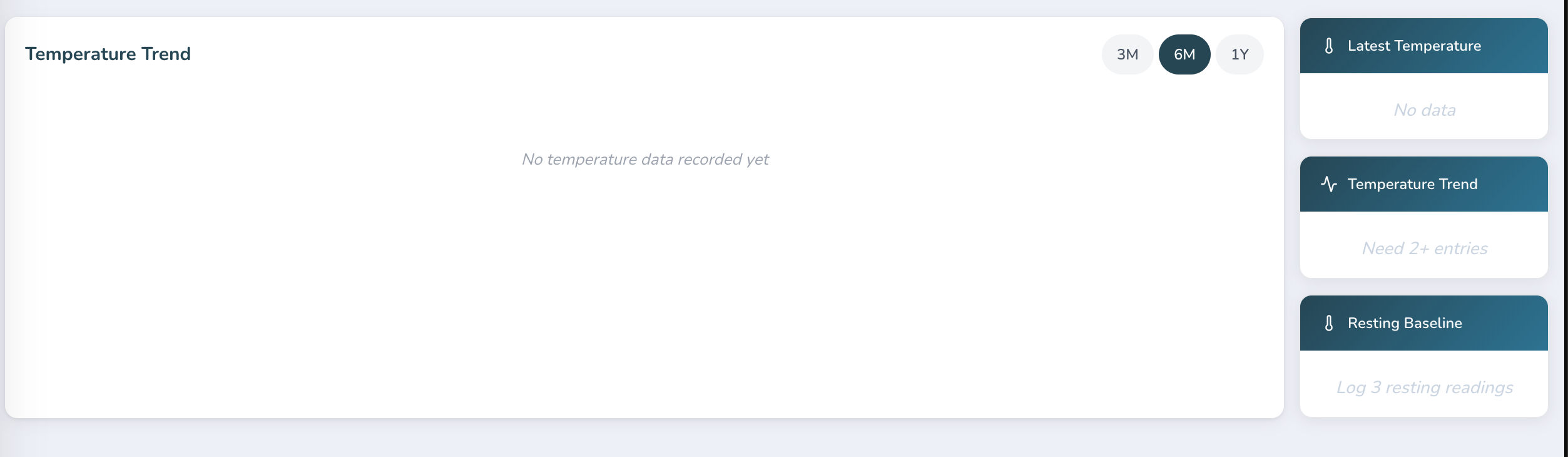
Below the guide, the Temperature Trend chart plots every reading over 3 months, 6 months or a year. Three cards sit next to it:
- Latest Temperature: the most recent reading and its label
- Temperature Trend: which way readings are heading, once you have two or more
- Resting Baseline: the dog's own resting average, after three resting readings
It matters even more for a team than for a single handler:
- One reading, one meaning. Every handler on the unit sees the same label for the same number. Nobody has to remember which chart applies.
- The record outlives the moment. Readings sit with the dog's weight, vaccines and vet visits, so the history is there when the vet, the team lead or the next handler asks.
- Your units, your choice. °F or °C follows your account setting, and readings logged in the other unit convert automatically.
- History stays honest. Each past reading keeps the label it earned for when it was taken, so a post-work spike from last July doesn't read as an emergency today.
It's decision support, not a diagnosis. But it means the whole team reads the same number the same way, and the record is there when the vet asks.