




Key Takeaways
- Courts judge a detection dog's reliability largely through its training and certification records. In Florida v. Harris (2013), a unanimous U.S. Supreme Court said those records can support probable cause, and that the defense gets to challenge them.
- ANSI/ASB Standard 088 says controlled training aids such as narcotics and explosives should be inventoried monthly by two people and signed in and out by two people.
- ANSI/ASB Standard 092 for explosives detection asks for a tracking code on every aid, linked to a log with a description, the date acquired and the quantity or weight, plus a documented source.
- Aid handling is far from standard across the field. In a 2025 survey of 188 human remains detection handlers, most replaced aids only as needed or at random, and many never replaced them at all.
- DogBase Inventory gives every aid a record from issue to disposal: custody moves with an authorizing officer and witness, inspections, expiry reminders, every session it was used in, and audit reports you can export.
Every detection alert sits on top of a training record. And every training record sits on top of an aid: a tin of birch, a bag of cocaine HCl, a few grams of TNT in a sealed can. If you can't say where that aid came from, who had it last and whether it was still good, the record above it gets weaker.
Most K9 units track their dogs carefully and their aids loosely. The aid log lives in a binder in the locker, or a spreadsheet one person keeps up, or nowhere at all. It works fine until somebody asks a hard question. An auditor. A certifying official. A defense attorney.
We just added Inventory to DogBase to close that gap. This post covers what the courts and the detection standards actually ask of training aid records, where most units fall short, and how the new module handles it.
Why do training aid records matter in court?

Because a dog's reliability gets argued from its training, and training is only as solid as the aids used in it.
In Florida v. Harris, decided February 19, 2013, the U.S. Supreme Court unanimously reversed a Florida ruling that had demanded extensive field performance records before a drug dog's alert could justify a search. Justice Kagan wrote for the Court that a dog's satisfactory performance in a certification or training program can, on its own, give a court good reason to trust the alert.
The same opinion gave the defense a roadmap. A defendant has to get the chance to challenge that evidence through cross examination or expert witnesses, including arguing that a program's standards were too lax, or digging into how the dog and handler actually performed in those assessments.
That's where aids come in. If a defense expert asks whether the narcotics aid used in last spring's certification was the same one the dog trained on every week, or whether the explosives aids were stored next to everything else in the magazine, the answer has to come from a record. "I think so" isn't a record.
Our reporting and court documentation page covers the training side. Aids are the layer underneath it.
What do the detection standards say about training aids?
The clearest guidance comes from the AAFS Standards Board, which publishes ANSI accredited standards for canine detection. Two of them speak directly to aids.
ANSI/ASB Standard 088, the general guidelines for training, certification and documentation across detection disciplines, says:
- Aids are handled and stored so they don't pick up contamination, in separate, individual, labeled containers, kept apart from other odors, including masking odors.
- Aids are disposed of and replenished as needed when they're contaminated or perishable.
- Controlled materials such as narcotics and explosives should be inventoried monthly by two people and signed in and out by two people.
- Aids are labeled in a way that supports accountability.
- Aids used for certification shouldn't be the same ones the team uses in everyday training.
ANSI/ASB Standard 092, written for explosives detection, goes further:
- Each aid carries a label with its tracking code or name, plus emergency contact information.
- Tracking codes link to a log that records, among other things, a description, the date acquired and the quantity or weight.
- Aids come from a reputable source, and that source is documented. Safety data sheets are on hand for every aid material.
- Aids are disposed of and replenished as needed because of contamination or because the material breaks down. A note in the standard says they're typically replaced every year.
None of this is exotic. It's a register, a label, a sign out with two people present, and a replacement schedule. The hard part is keeping it current every week, across every handler, locker and vehicle.
Where do aid records usually break down?
Mostly in the gaps between people. An aid gets pulled for a Tuesday session, handed to a second handler for Thursday, and goes back in the box on Friday without anyone writing it down. Now multiply that by a dozen aids and three vehicles.
Age and replacement are the next weak point. A 2025 review and handler survey in Forensic Science International: Synergy by Whaley, Greco, Mercando, Dargan and DeGreeff asked 188 human remains detection handlers how they source and store their aids. Most replaced aids as needed or at random rather than on any schedule, and many never replaced them. Storage varied just as much: 64.4% used a freezer, while 45.7% kept at least some aids with no temperature control. The authors described the practices as highly heterogeneous.
HRD isn't narcotics or explosives, but the pattern carries over. When nobody tracks how old an aid is or how it's been stored, nobody can say whether the dog is still training on the odor it'll meet on a real search.
Contamination is the third problem. Researchers are still measuring how odor moves between aids. A 2024 study by Davis and Goodpaster in Forensic Chemistry looked specifically at cross contamination of explosive training aids during manufacturing and storage. It's the same concern behind the ASB rules on separate, labeled containers. And if an aid's storage history was never recorded, contamination is very hard to rule out after the fact.
What should a training aid record hold?
Put the court ruling and the standards side by side and a defensible aid record answers six questions:
- What is it? Odor, composition, container, quantity, and a unique ID on the label.
- Where did it come from? The source and the date acquired.
- Who has it right now? And who had it before, where, and when it changed hands.
- Who signed off? An authorizing officer and a witness for every move.
- Is it still good? Expiry, inspection results, and when the next check is due.
- What was it used for? Every training and deployment it touched, and how it was finally retired or disposed of.
Paper can hold all of that. It just can't search it, total it up, or remind you before something lapses.
How DogBase Inventory handles it
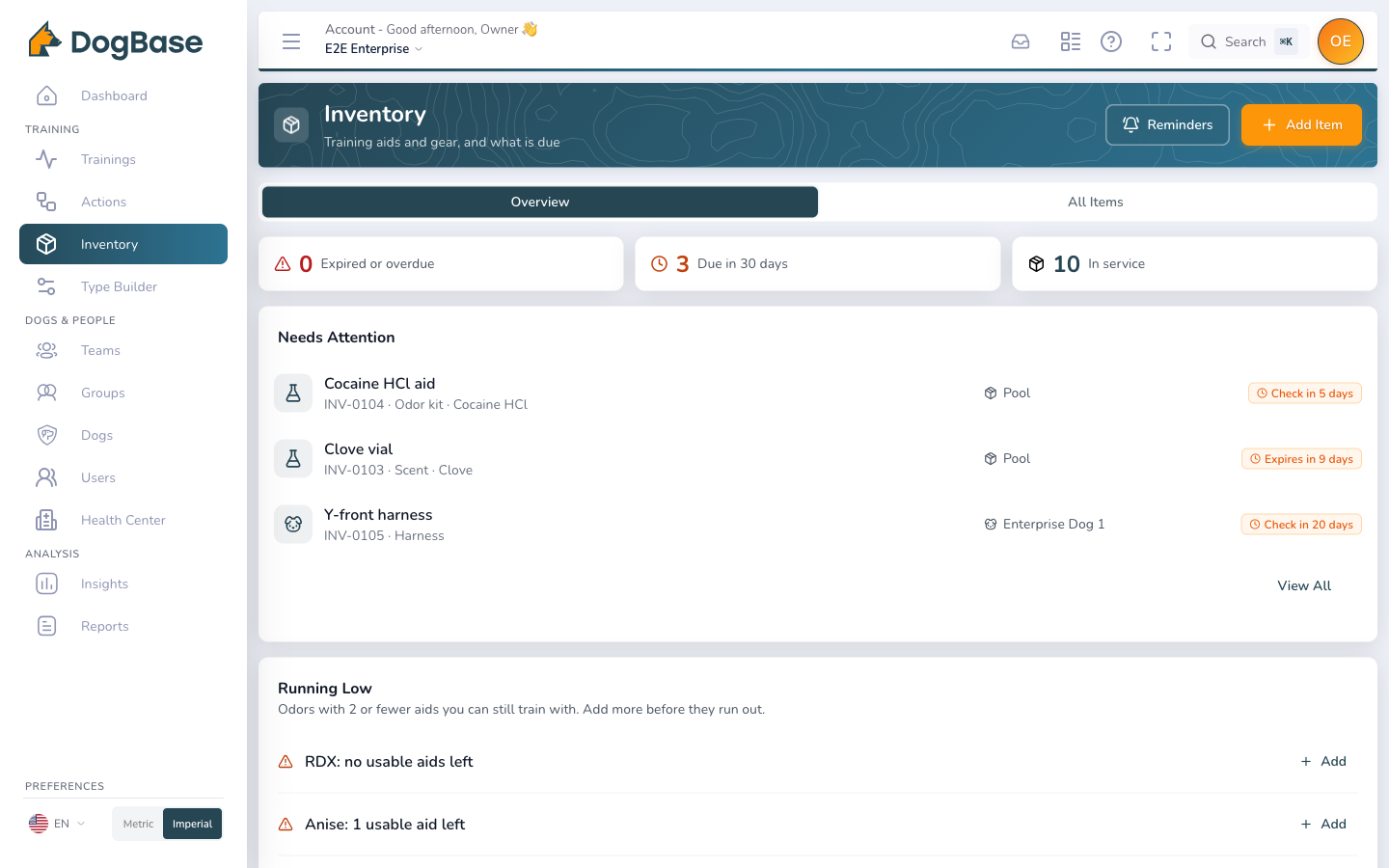
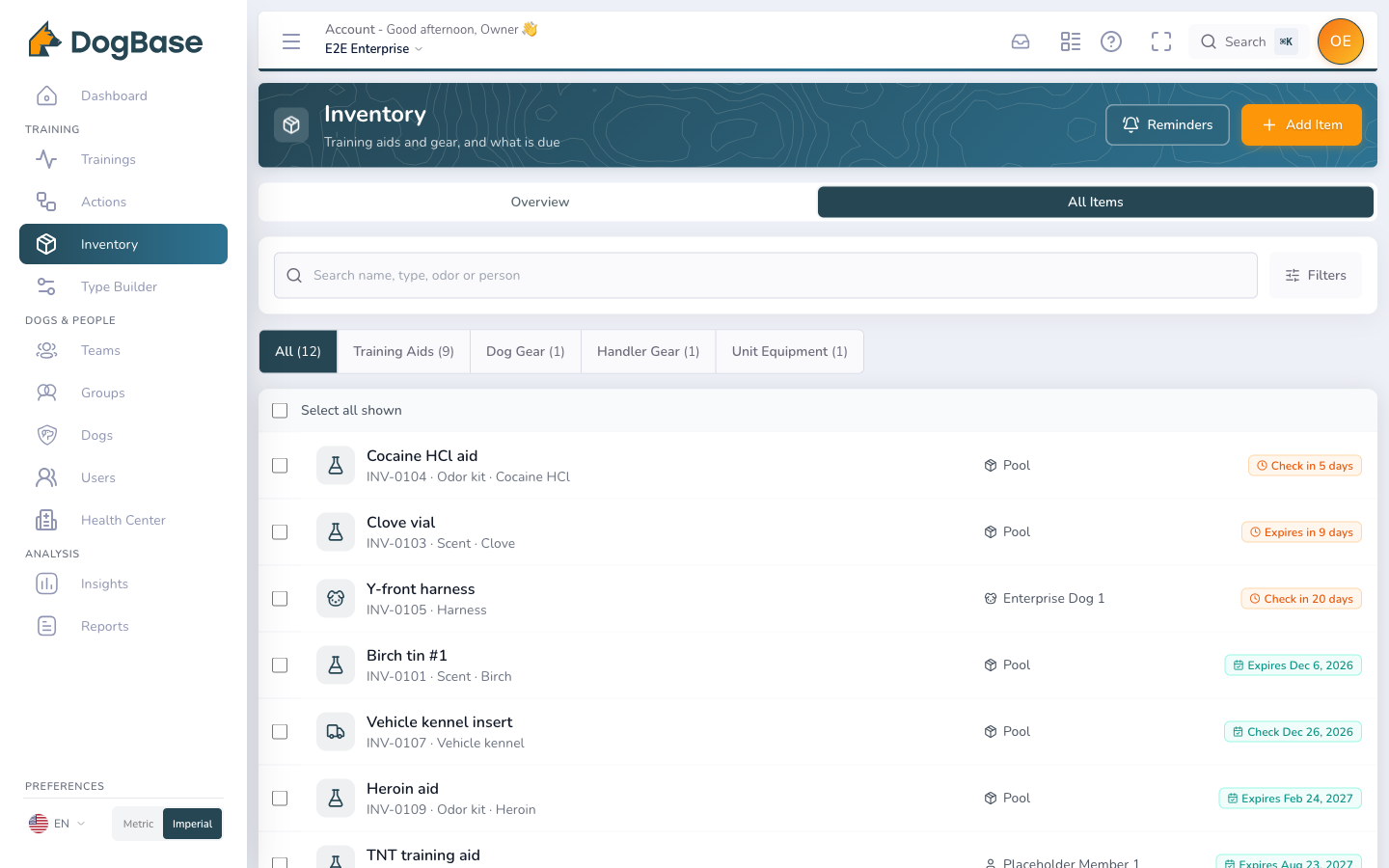
Inventory is a new module that puts training aids and equipment in the same system as the dogs and records that use them. Items are grouped into training aids, dog gear, handler gear and unit equipment, and each kind gets the fields that fit it.
One Overview for what needs attention. The Overview shows what's expired or overdue, what's due in the next 30 days, and how much is in service. A Running Low list flags any odor where you're down to two or fewer usable aids, so you restock before the dog runs out of odor to train on.
Expiry and check reminders. Aids can expire by date, by number of uses, or after opening. DogBase reminds you before an aid lapses or a check comes due.
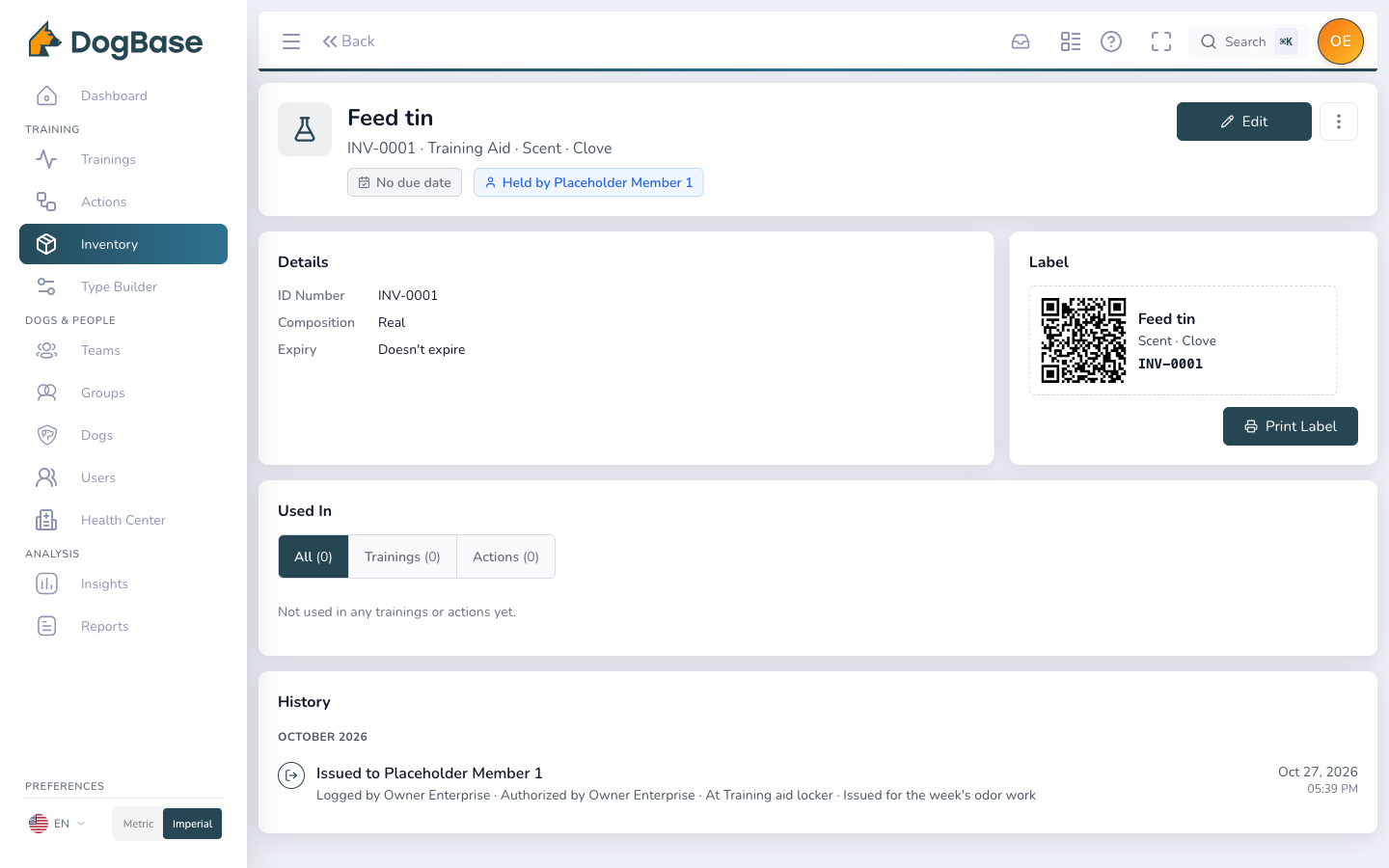
Chain of custody on every move. Issue, transfer and return items with a location, an authorizing officer, a witness and a note. Inspection results and disposal records land on the same History timeline. Retire an aid and link it to its replacement. Once an aid is disposed of, its record goes read only, so nothing can change after the fact.
Every session an aid was used in. Handlers record which aids they used right inside a training or action. Each item page has a Used In section listing every training and action that touched it, plus a QR label with the item ID that you can print and stick on the container.
Reports you can hand to an auditor. Under Reports, Inventory adds a Register, an Activity Log, a Usage report and an Audit Report, all exportable to Excel or CSV. The Activity Log lists every receipt, issue, transfer, return, inspection and disposal in a date range. You can batch print item PDFs and QR labels, and filter Insights by item, type and odor.
Roles that match how units work. Admins add, edit, reactivate and dispose of items. Members record inspections, handle custody, retire items and export item PDFs. The Audit Report is admin only.
Line that up against ASB 088 and 092 and it covers the core asks: a labeled ID, a register with source and date, custody moves with two people named, inspections, and replacement you can see coming. DogBase doesn't make a program compliant on its own, though. Your policy still decides who signs, how often you count and when aids get replaced. DogBase makes sure it gets written down every time.
Version history on every training and action
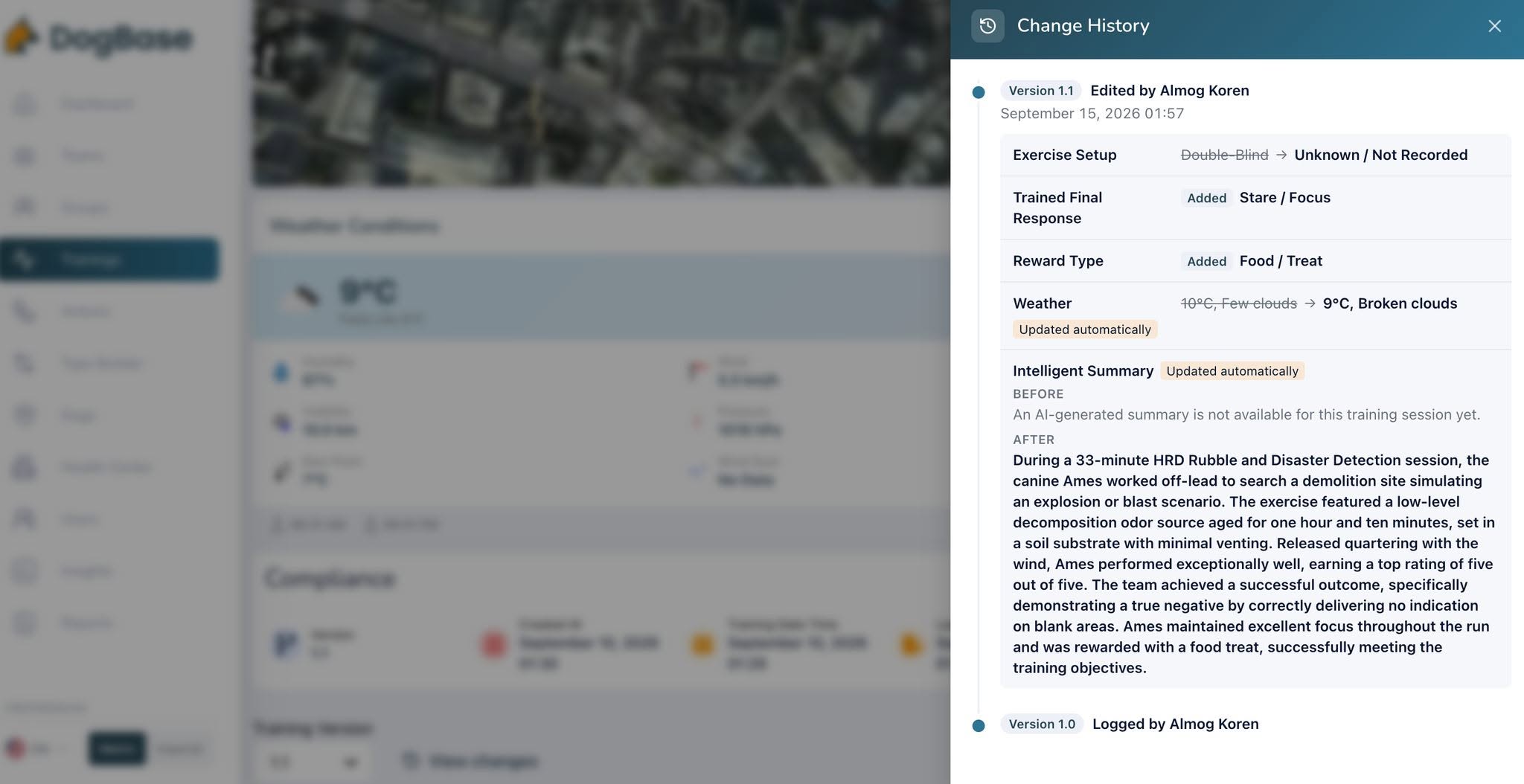
The same release adds a full edit history to trainings and actions. Open any record and select View changes to see every version, who made each edit, when, and exactly what changed, like a distance going from 50 m to 80 m. Fields DogBase fills in on its own, such as weather or the AI summary, are tagged "Updated automatically," and every record now shows who edited it last.
Put the two together and you can answer the questions a defense expert actually asks. Which aid did the dog train on that day? Who had it? And has the record been touched since?
A simple aid routine to start this week
You don't need to move everything over on day one. Start with the aids that carry the most risk.
- Register your controlled aids first. Narcotics and explosives. Give each one an ID, its source, the date acquired and the quantity, then print the QR label and put it on the container.
- Issue each aid to whoever holds it today. That gives you a clean starting point for custody.
- Set expiry and check dates. Follow your own policy. If you don't have one yet, the ASB 092 note about yearly replacement for explosives aids is a reasonable place to start the conversation with your supervisor.
- Log aids in every session from now on. It takes a few seconds in the training form, and it builds each aid's Used In history for you.
- Keep certification aids separate. Mark them so they never show up in routine training, as ASB 088 recommends.
- Run the monthly count with two people. Export the Register, check it against the locker, and record an inspection on anything that looks off.
If you're on a trial, every Inventory feature is open to you right now. Teams working detection, law enforcement or air cargo screening can start a free trial, or book a demo and we'll set up your first aids with you.
Frequently Asked Questions
What is chain of custody for K9 training aids?
It's a documented history of every person who held an aid, where they held it, when it changed hands and who authorized each move, from the day the aid is acquired to the day it's disposed of.
How often should training aids be inventoried?
ANSI/ASB Standards 088 and 092 recommend that controlled aids, such as narcotics and explosives, be inventoried at least monthly by two people and signed in and out by two people. Your agency, state or country may require more.
How often should explosives training aids be replaced?
ANSI/ASB Standard 092 says to dispose of and replenish aids as needed because of contamination or because the material breaks down, and notes that aids are typically replaced every year. It doesn't set a fixed expiry date.
Can DogBase track gear and equipment too?
Yes. Besides training aids, Inventory covers dog gear like harnesses and vests, handler gear, and shared unit equipment like vehicle kennel inserts, each with assignments, regular checks and reminders.
Which DogBase plans include Inventory?
The Handler plan includes up to 15 items. Custody tracking starts on the Team plan, and transfers, inspection results and disposal records are available on Unit and above. Trials get the full Unit limits. See pricing for details.
Does DogBase replace our agency policy or legal requirements for holding aids?
No. Rules for possessing, storing and transporting controlled substances and explosives vary by country and state, and your agency policy still applies. DogBase is where you record what you do, so the record is complete when someone asks for it.